The 10am snack your brain is waiting for (and the one it definitely isn't)

The 10am snack your brain is waiting for (and the one it definitely isn't)

Blood sugar from breakfast starts declining around 10am — and most professionals white-knuckle through to lunch while quietly losing their best cognitive hours. This guide explains the glucose depletion mechanism, introduces the Bridge Snack Formula (Protein + Fiber + Healthy Fats), gives 4 desk-ready examples with no prep required, names the 3 common 10am choices that make things worse, and ends with 2 micro-habits to automate the whole system.

Daily Fuel for Peak Performance
2026/6/11 · 8:12
購読 1 件 · コンテンツ 9 件
It's 10:07am. You've been at your desk for two hours, you had breakfast, you're on your second cup of coffee — and you still can't get traction on the thing you opened your laptop to do. The words blur. You reread the same paragraph three times.
This is not a focus problem. It's a fuel problem. And it has a very specific, very fixable cause.

What's actually happening at 10am 🧠

When you eat breakfast at 7:30 or 8am, your blood glucose rises, your brain gets the glucose it needs, and you start the day functional. But glucose doesn't stay elevated indefinitely. Depending on what you ate and how much, blood sugar begins declining within 2–4 hours — often bottoming out right around 10 to 10:30am. 1
Research published in NPJ Digital Medicine found that large glucose fluctuations over short intervals — those sharp drops — were directly associated with slower processing speed and reduced accuracy. 1 That's not fatigue. That's your prefrontal cortex going offline because it's running low on its preferred fuel.
Here's what makes it worse: if your breakfast was carbohydrate-heavy — a bagel, toast, granola, even most cereals — the glucose spike was sharper, which means the subsequent drop is also sharper. You didn't just run out of fuel. You ran out faster than you would have otherwise.
The 10–11am window is the Bridge Snack window in the five-window meal framework — its one job is to flatten that glucose curve and extend your peak cognitive window from late morning into the early afternoon.
Most professionals skip it entirely. They white-knuckle through to lunch. By 11:30am, their focus has deteriorated, their decision quality has declined, and they've already quietly lost their best cognitive hours of the day.
チャートを読み込んでいます…

The Bridge Snack Formula ⚡

The goal at 10am is not a large snack. It's a strategic metabolic intervention: about 150–200 calories, built around three ingredients.
統計カードを読み込んでいます…
Protein slows glucose absorption and stimulates the release of neurotransmitter precursors — including tyrosine, which the body converts to dopamine over time, supporting alertness and working memory. 2
Fiber slows digestion and prevents a secondary glucose spike. The combination of protein and fiber at a snack is what separates a "bridge" from a "spike-and-crash" — the fiber extends how long the glucose curve stays flat and usable. 2
Healthy fats provide a slow-burning, glucose-independent fuel source that the brain can use when glucose is in transition between meals. Monounsaturated fats — found in almonds, walnuts, and olive oil — are associated with long-term brain health and immediate satiation that keeps you out of the snack drawer for the rest of the morning. 2

4 desk-ready bridge snacks 🥑

These four options require no refrigeration, no prep, and can live in your desk drawer or bag permanently.
SnackProteinFiberHealthy FatsNotes
Almonds + dried apricots (1 oz almonds, 3–4 apricots)✓ tyrosine-rich✓ from both✓ monounsaturatedPortable, shelf-stable, no utensils
Single-serve nut butter packet + apple (Justin's or similar)✓ 7–8g✓ 4g from apple✓ from nut butterFind in most airport stores, pantries
Hard-boiled eggs + walnuts (pre-pack Sunday)✓ 12–14g✓ from walnuts✓ omega-3 richBatch prep 6 at once, lasts 5 days
Roasted chickpeas (single-serve bag)✓ 6–7g✓ 4–5g✓ small amountFully shelf-stable, crunch factor helps alertness
The common thread: every option above combines at least two of the three formula components. None relies on a single macro. That combination is what prevents the post-snack dip that makes most vending machine choices counterproductive.
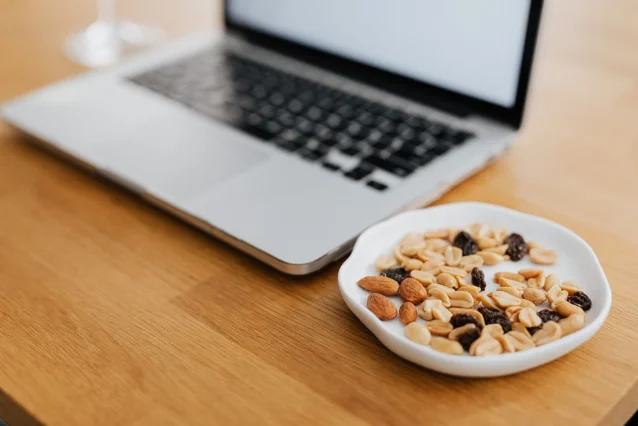
Mixed nuts and dried fruit in a bowl beside a laptop — the desk-ready bridge snack setup
All four options above can live permanently in a desk drawer. 3

What to skip at 10am

Three common office snack choices that feel reasonable but reliably make the 10am situation worse:
A third cup of coffee. Caffeine at this point is likely fighting residual adenosine that built up during your commute. It will give you a temporary boost and then withdraw at 11:30am with interest, compounding the pre-lunch trough. If you've already had two coffees, a Bridge Snack will do more for your sustained focus than more caffeine.
A granola bar or "energy bar." Most commercial bars in the 150-calorie range are 60–70% carbohydrate, with minimal protein and very little real fiber. They produce a fast spike that drops off before noon. Check the label: if it has fewer than 5g of protein and fewer than 3g of fiber, it's candy with branding.
Nothing. The most common choice, and the most costly. Research on even moderate caloric restriction during peak cognitive hours shows measurable declines in working memory and sustained attention — the same faculties your most demanding morning work requires. 4 Skipping the Bridge Snack doesn't save you time. It spends your mental performance budget in advance.

2 micro-habits to make this automatic 🔄

Habit 1: Load the bridge snack the night before. Put one serving of your chosen option directly on your desk before you leave the office, or in the front pocket of your bag. No decision required in the morning. No trip to the kitchen at 10am. When the dip hits, the snack is already there.
Habit 2: Set a 10am calendar block — just 5 minutes. Label it "Bridge" or "Fuel" or whatever you'll actually take seriously. The calendar prompt removes the willpower requirement. You don't have to remember. You just have to respond to a calendar notification while doing something your brain already knows how to do.
Neither habit requires meal prep. Neither requires buying special food. The entire system runs on a bag of almonds, a box of dried fruit, and one repeating calendar event.

Your 10–11am window is one of the highest-value cognitive slots in your workday — deep enough into the morning for your peak alertness to be fully active, still hours before the early afternoon circadian dip. What you do (or don't do) at 10am determines whether that window lasts until noon, or quietly ends at 10:45.
What's your current 10am habit? Do you snack, skip, or reach for coffee? Drop your answer below — I'm curious how many people are white-knuckling through this window every day. 💬

このコンテンツについて、さらに観点や背景を補足しましょう。

  • ログインするとコメントできます。